
If you employ staff, you may already have opened an ATO super guarantee letter that starts like this:
“Your data shows you may not have met your quarterly super guarantee (SG) obligations.”
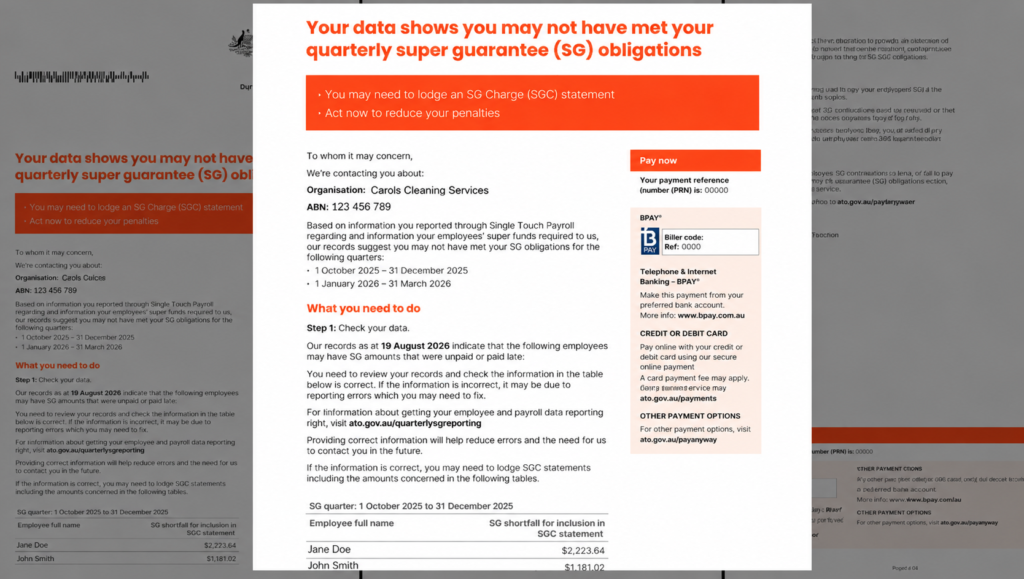
Example only: a mock-up of an ATO super guarantee “nudge” letter.
It’s in bright orange and it lists your employees by name, with a dollar figure next to each one. It tells you that you may need to lodge a Super Guarantee Charge (SGC) statement and to “act now to reduce your penalties.”
Even if you’re sure you paid everything on time, that’s a stressful letter to receive.
First, take a breath
The ATO calls these “SG nudge letters.” It has said a nudge letter is not an assessment and does not impose penalties. It’s a prompt to check your records, fix any reporting errors and pay any genuine shortfall.
Some employers who believe they paid everything on time have still received one. The issue was even raised in a Senate committee hearing in October. So if your letter doesn’t look right, you’re not alone.
Please don’t ignore it, though. Check your records and act on what you find.
Why are these letters arriving now?
The ATO can now compare two sets of data side by side:
- What you reported through Single Touch Payroll (STP). This is the super your payroll says was owed.
- What your employees’ super funds reported. This is the super that actually arrived, and when it arrived.
If those two don’t match, a letter can be generated. The cause could be a real shortfall, a late payment, or just a reporting error somewhere between your payroll, your bank and the fund.
Payday Super has raised the stakes
The current letters relate to quarters under the old quarterly system. Since 1 July 2026, though, Payday Super requires employers to pay super at the same time as wages. Contributions must be received by the employee’s fund within 7 business days of payday.
The same data matching that produces these letters now applies to every pay run. For super to arrive on time, four separate systems all have to work together:
- Your accounting/payroll software has to calculate the super correctly and report it through STP.
- Your bank has to process the payment on time.
- Your clearing house or payment channel has to pass it on, with the right details.
- Your employee’s super fund has to receive it, match it to the right member and report it back to the ATO.
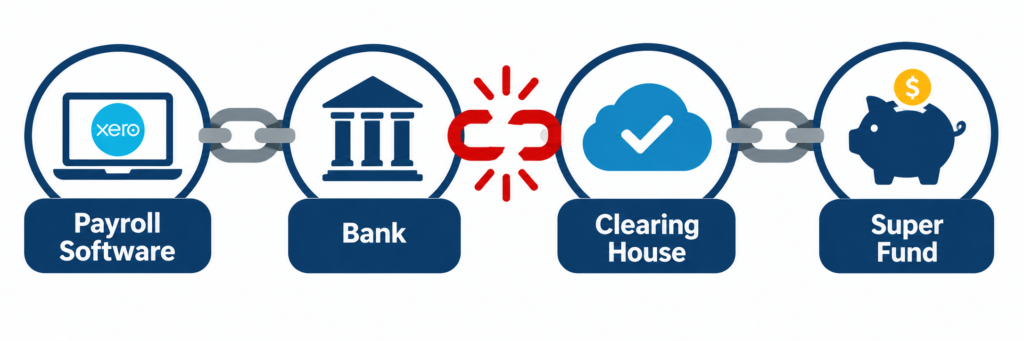
How do you actually know all four are working together? If one link breaks, such as a wrong USI, a rejected contribution, a payment that sat in a clearing house, or an STP mapping error, you may not find out until the ATO tells you.
Be kind to yourself
These systems are new. Software providers, funds and the ATO are all still ironing out the creases, and I’m confident things will improve as small businesses work through these letters.
That doesn’t make it less stressful when one lands on your desk, though. That’s why I’m building something to help.
Coming soon
1. Payday Super – Are You Compliant?
This will be a downloadable resource pack to help you check your own setup, follow a contribution from payroll to fund, spot where things commonly go wrong, and know what to do if you receive one of these letters.
👉 Payday Super: register your interest here
Fill in the short form and you’ll be the first to be notified when the resources go live.
This article is general information only and doesn’t take your personal circumstances into account. If you’ve received an ATO letter, check your records and get advice if you’re unsure. More information is on the ATO website.
References
- ATO – Missed and late super guarantee payments (quarterly, to 30 June 2026)
- ATO – Super guarantee charge (SGC) statement
- Accountants Daily – ‘Aggressive’ SGC letters from the ATO come rolling in
- Accountants Daily – ATO faces the music over alleged incorrect SGC data saga
- Sterlinx Global – ATO grilled in Senate over super nudge letters